What to Do After a Pipe Bursts in Your Spring TX Home
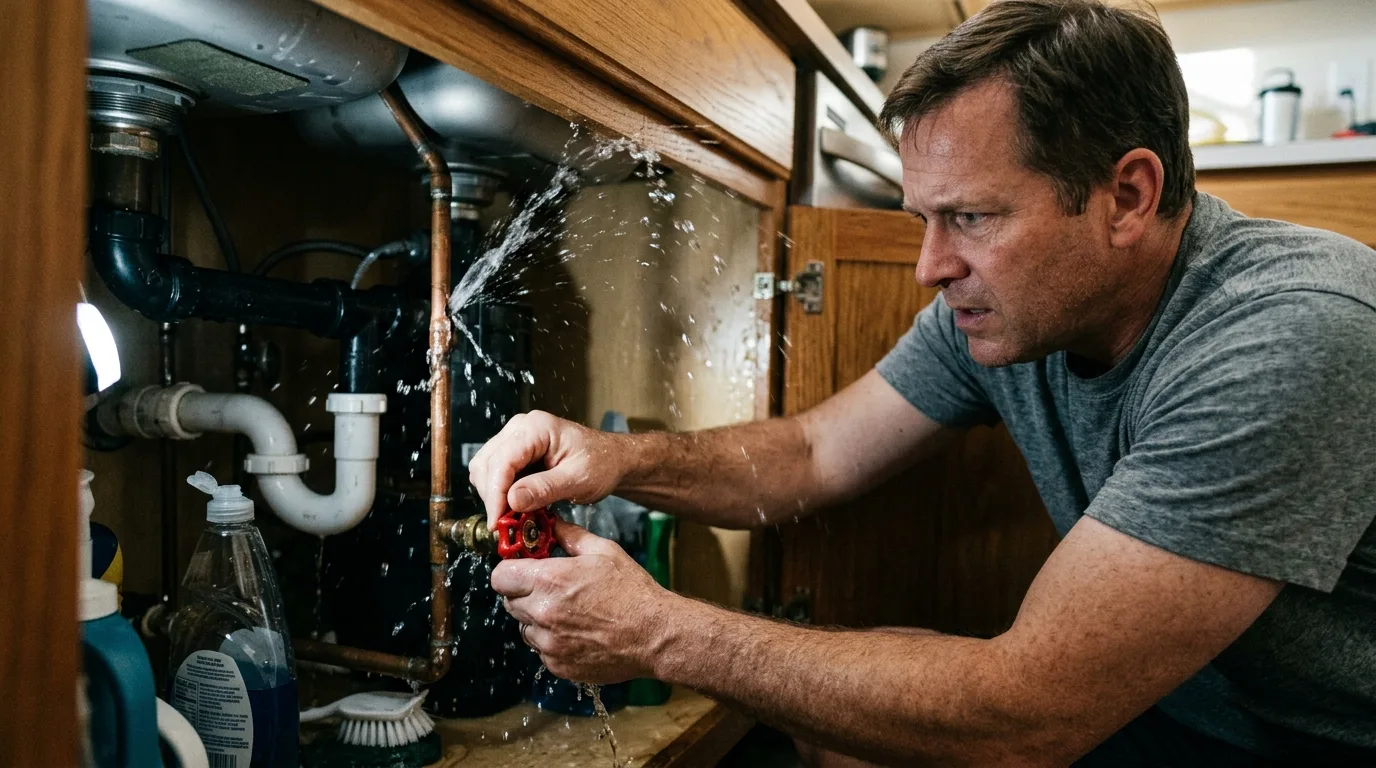
A pipe has just burst in your Spring, TX home. What you do in the next 30 minutes will determine whether this is a $2,000 problem or a $20,000 one. This guide gives you the exact steps, in order, based on what actually stops damage from escalating — not what sounds reassuring in a panic.
In this post, we cover the immediate shutdown steps that stop water from spreading, how to document the damage properly for your insurance claim, when you need professional restoration (not just cleanup), and what the restoration process looks like so you know what to expect.
Burst Pipe in Spring TX? Call Now — 60-Minute Response
Spring Water Damage Restoration deploys immediately after pipe bursts across Spring and Harris County. Call (877) 698-1311.
Step 1: Shut Off the Water Immediately
Your first action is to stop the water source, not to investigate the damage. Every second the pipe continues running, water is migrating further along structural pathways — following floor joists, running between wall studs, saturating insulation you can’t see.
Find your main water shutoff. In Spring, TX homes, the main shutoff is typically located at the water meter, which is usually in the yard near the street. It may also be in a utility room, under a sink, or in a mechanical closet. If you don’t know where your shutoff is, find it now — before an emergency — and make sure every adult in the household knows its location.
If it’s a supply line to a single fixture: shut off the individual stop valve under the sink, behind the toilet, or behind the appliance. This isolates the damaged line without affecting the rest of the house.
If you can’t find the shutoff: call the city or a licensed plumber immediately. Do not wait. A pipe running for 15 minutes floods more area than one running for 2 minutes.
Step 2: Shut Off Electricity in Flooded Areas
Water and electricity are an immediate safety hazard. Before entering a flooded area, determine whether any electrical outlets, appliances, or wiring are in or near the water. If so, shut off the circuit breaker for that area before entering.
Do not wade through standing water to reach the breaker box if the box is in the flooded area. Call Spring Water Damage Restoration or your local fire department instead — they have the equipment to assess electrical safety in flooded spaces.
Step 3: Document Everything Before Touching Anything
This step is critical for your insurance claim and most homeowners skip it in the rush to start cleanup. Do not start mopping, moving items, or extracting water before you have documentation.
Use your phone to take:
- Wide shots of every affected room showing the full extent of visible water
- Close-up photos of the burst pipe or point of failure
- Photos of all wet materials — carpet, drywall, flooring, personal property
- Video walkthroughs with audio narration describing what you see
Record the date and time. Your claim will require documentation of when the event was discovered. Timestamps on photos establish the timeline.
This documentation exists to support your claim. The more complete it is, the less friction you’ll encounter with your insurance carrier. We generate additional documentation from the moment we arrive — but the photos you take before we get there capture conditions that cannot be recreated.
Need Help Documenting Your Pipe Burst Claim?
We assist Spring TX homeowners through the full insurance documentation and claim process. Call (877) 698-1311.
Step 4: Call a Water Damage Restoration Team — Not Just a Plumber
A licensed plumber fixes the pipe. A water damage restoration team addresses what the water did after it left the pipe — and those are two entirely different scopes of work. Many Spring homeowners make the mistake of calling a plumber, having the break repaired, and then attempting to dry out the home themselves. This approach regularly leads to hidden moisture in wall cavities and subfloor materials that produces mold colonies within weeks.
In Spring’s humid subtropical climate, the 24–48 hour window before mold can establish in wet materials is not a guideline — it’s a hard constraint. Burst pipe water extraction and structural drying require industrial-grade equipment (truck-mounted extractors, commercial air movers, and calibrated dehumidifiers) and moisture monitoring to verify drying is complete. Consumer fans and dehumidifiers are not adequate for materials that have absorbed water into wall and subfloor cavities.
Call a restoration team and a plumber simultaneously if the pipe is actively running. The restoration team will coordinate with the plumber to begin extraction as soon as the water source is stopped.
Step 5: Begin Removal of Salvageable Items
While waiting for the restoration team, move undamaged items away from the wet area. Furniture that is not yet wet should be moved to dry areas. If furniture is already wet at the base, photograph it before moving it — and understand that furniture sitting in water for more than a few hours is often not salvageable.
Do not begin demolishing walls or pulling up flooring before the restoration team arrives. Their initial moisture mapping assessment identifies exactly which materials need to come out and which can be dried in place — and pulling materials prematurely can actually disrupt the assessment and create additional work.
What the Restoration Process Looks Like
After the restoration team arrives, expect a defined process:
Moisture mapping and assessment (day 1): Using thermal imaging cameras and calibrated moisture meters, the team identifies all areas where water has migrated — including areas you cannot see. This is why getting a restoration team on-site quickly is so important — the full damage picture is established before any drying equipment is set.
Water extraction (day 1): Truck-mounted extractors remove standing and pooled water. Secondary extraction equipment removes water from carpet, padding, and subfloor materials.
Structural drying setup (days 1–2): Air movers (not fans) and industrial dehumidifiers are positioned based on the moisture map to dry structural materials at the optimal rate. Drying too fast causes material cracking; drying too slow allows mold. IICRC-certified technicians balance both.
Daily monitoring (days 3–7 typically): Moisture readings are logged daily. Equipment is repositioned as drying progresses. The process ends when all structural materials reach target moisture levels confirmed by calibrated readings — not by feel or appearance.
Demolition and reconstruction (after drying): Materials that cannot be dried in place — Category 2 or 3 water-affected porous materials, structurally saturated framing — are removed and replaced. For burst pipe water extraction in Spring, the typical timeline is 3–7 days of active drying before reconstruction can begin.
Frequently Asked Questions
How long after a pipe burst does mold start in Spring, TX?
Mold can begin establishing in wet materials within 24–48 hours in Spring’s humid subtropical climate — faster than in drier regions. This isn’t a worst-case scenario; it’s the baseline expectation in our climate. Getting a restoration team on-site within the first few hours after a pipe burst is the most effective mold prevention measure available. See our guide on mold after water damage in Spring for detail on what to watch for.
Will my homeowners insurance cover a burst pipe in Spring, TX?
Standard Texas homeowners insurance covers sudden and accidental water damage from a burst pipe — yes. The key word is “sudden”: a slow leak you were aware of and didn’t repair is typically excluded. The claim process requires documentation of the event date, photos of the damage, and a detailed scope of work from the restoration contractor. Our insurance claim guide for Spring walks through the full process.
How much does burst pipe restoration cost in Spring, TX?
Burst pipe restoration in Spring ranges from approximately $2,000 for a clean break caught quickly, to $5,000–$70,000 for a pipe that ran for hours or went undetected for days. The wide range reflects the difference in structural involvement. See our full cost guide for Spring, TX for a detailed breakdown by scenario.
Burst Pipe in Spring TX — Call Now for Immediate Response
Spring Water Damage Restoration handles burst pipe extraction and drying 24/7. IICRC certified. Call (877) 698-1311.
Related: